
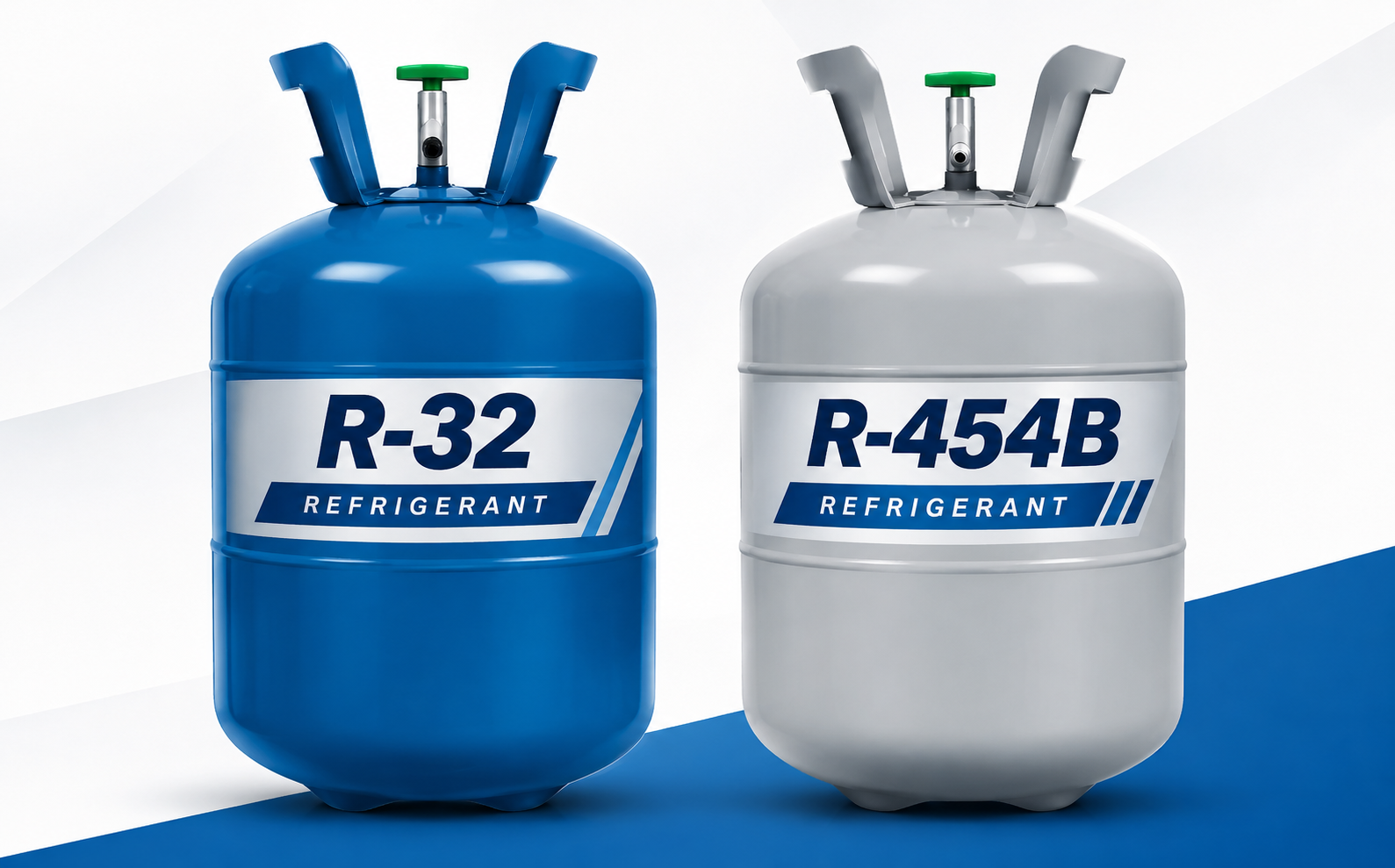
As HVAC manufacturers develop equipment using lower-global-warming-potential refrigerants, R-32 and R-454B are two alternatives to consider. Understanding their differences helps building owners and facility teams plan equipment selection, service, and future replacements.
Why the refrigerant transition matters
R-410A has been widely used in HVAC equipment, but its global warming potential (GWP) has prompted a shift toward lower-GWP alternatives. Under the American Innovation and Manufacturing (AIM) Act, the U.S. Environmental Protection Agency is implementing an 85% phasedown of HFC production and consumption from historical baseline levels by 2036. This is a phasedown, not a blanket ban on servicing existing R-410A equipment.
R-32 and R-454B are two lower-GWP refrigerants used in equipment specifically designed for them. Both have an ASHRAE A2L safety classification, meaning lower flammability, and neither can simply be charged into an existing R-410A system as a drop-in replacement. EPA HFC reduction program; U.S. Department of Energy refrigerant comparison.
R-32 vs. R-454B: key differences
| Property | R-32 | R-454B |
|---|---|---|
| Composition | Single-component HFC (difluoromethane) | Blend of R-32 (68.9%) and R-1234yf (31.1%) |
| 100-year GWP (IPCC AR4) | 675 | 466 |
| ASHRAE 34 classification | A2L | A2L |
| Use in existing R-410A equipment | Not a drop-in replacement | Not a drop-in replacement |
| Efficiency and charge | Depend on equipment design, operating conditions, and manufacturer specifications | |
These GWP figures use the same IPCC Fourth Assessment Report basis for a consistent comparison; other assessment editions report different values. Source: ASHRAE Handbook refrigerant table.
What to know about R-32
R-32 is difluoromethane, a single-component refrigerant with a 100-year GWP of 675 on the IPCC AR4 basis. Its GWP is substantially lower than R-410A’s value of 2,088 on the same basis.
R-32 is classified A2L, so installation, leak detection where required, servicing, and handling must follow applicable safety standards, codes, and manufacturer instructions. Equipment design influences performance: the original Wix article described potential efficiency gains and smaller charges, but those outcomes should not be assumed for every R-32 installation.
R-32 is not approved as a universal retrofit refrigerant for existing R-410A equipment. DOE comparison.
What to know about R-454B
R-454B is a refrigerant blend composed of approximately 68.9% R-32 and 31.1% R-1234yf. Its 100-year GWP is 466 on the IPCC AR4 basis, lower than R-32 and considerably lower than R-410A.
Like R-32, R-454B is classified A2L. The original Wix article called it nonflammable and described it as a drop-in replacement for R-410A; neither statement is correct. R-454B must be used only in compatible equipment designed and approved for that refrigerant.
Its operating characteristics can be closer to those of R-410A than R-32 in certain respects, but this does not remove the need for application-specific equipment and safety design. DOE refrigerant comparison.
How should facilities evaluate the choice?
The choice is not simply which refrigerant has the lowest GWP. Facility managers and project teams should evaluate the complete equipment and application, including:
- Manufacturer-approved refrigerant and equipment compatibility.
- Applicable building, mechanical, and fire safety requirements for A2L systems.
- Cooling and heating loads and expected operating conditions.
- Equipment efficiency, refrigerant charge, and service access.
- Technician training, maintenance practices, and long-term equipment support.
Because R-32 and R-454B are not interchangeable, refrigerant selection must follow the equipment manufacturer's specifications. For related technical education, explore HMS training resources.
Frequently asked questions
Is R-454B nonflammable?
No. R-454B and R-32 are both A2L refrigerants, a lower-flammability classification under ASHRAE Standard 34.
Can R-454B replace R-410A in an existing system?
No. R-454B is not a drop-in replacement for R-410A; equipment must be specifically designed and approved for its use.
Which refrigerant has the lower GWP?
On the IPCC AR4 100-year basis, R-454B has a GWP of 466 versus 675 for R-32. Both are lower than R-410A at 2,088.
Does lower GWP always mean lower energy costs?
No. GWP measures a refrigerant's climate impact relative to carbon dioxide over a specified period. Equipment efficiency and operating costs depend on system design and operating conditions.
Technical references
- U.S. EPA — HFC Reduction Program
- U.S. Department of Energy — R-410A alternatives: R-454B and R-32
- ASHRAE Handbook — Halocarbon and Hydrocarbon Refrigeration Systems
Original Wix article also referenced Daikin's R-32 and R-454B comparison. Its system-level emissions and charge-size figures have not been generalized here.